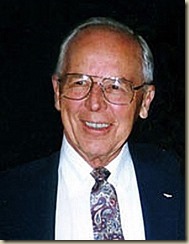
 George Spangenberg (June 22, 1912 – November 13, 2000) was head of aircraft design in the United States Navy's Naval Air Systems Command.
"After a long career in Naval Aviation, Mr. Spangenberg retired from NAVAIR in 1973 where he had served as Evaluation Division Director, Naval Air Systems Command, for 15 years. He is credited with a long array of successful aircraft designs procured for the Navy over a 40-year period and served as spokesperson on naval aircraft design for the Navy, OSD, and Congress. Mr. Spangenberg was widely recognized for his technical expertise, integrity and business sense within and outside the government service. His abiding desire was to see that our Naval Aviators were flying the best machine possible; he never faltered from that mission up to the time of his death. He worked closely with Navy officers, civil service and industry engineers at all levels to accomplish this goal.
He was responsible for the design requirements/procurement of many aircraft, including the F4H Phantom aircraft, the Mach2 fighter-bomber F-14 Tomcat, the land and carrier based maritime patrol airplanes P-3 Orion and S-3 Viking, the carrier command and control aircraft E-2 Hawkeye and the Marine Corps heaviest lift helicopter CH-53E Super Stallion and selection of the YF-17 and design of the F/A-18 Hornet for the US Navy." (Except from original Spangenberg website.
George Spangenberg is on the National Air and Space Museum's Wall of Honor as an Air and Space Leader.
Note: At a request, I am making sure we don't lose the memories of this important aviation pioneer!
Click here to download history (0.6 Meg)
Alternate download here


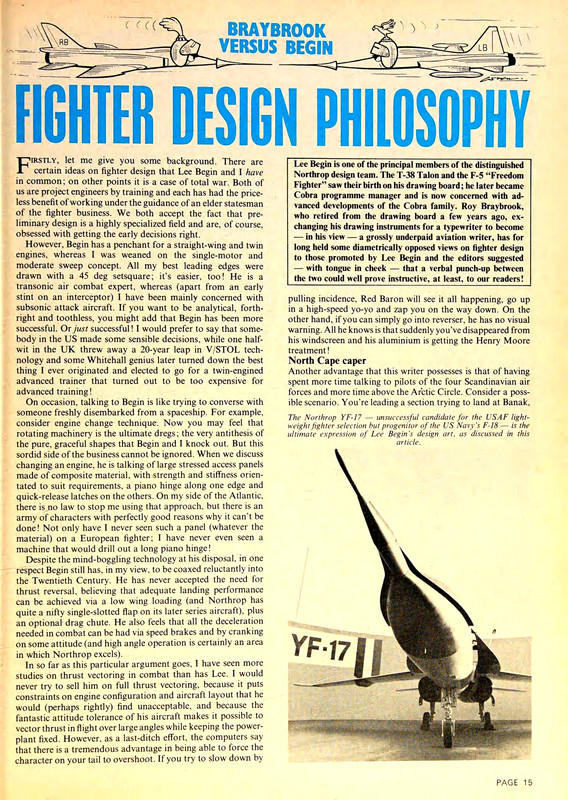 A copy of a very interesting article on the Northrup F-5 & YF-17 Fighter Design Philosophy. From the Air International magazine, Vol.10 of January 1976.


 From Wikipedia: “Have Doughnut was the name of a Defense Intelligence Agency project whose purpose was to evaluate and exploit a MiG-21 "Fishbed-E" that the United States Air Force acquired in 1967 from Israel. Israel acquired the aircraft as the result of its Operation Diamond when, on August 16, 1966, Iraqi Air Force pilot Capt. Munir Redfa, in a defection pre-arranged by the Israeli Mossad intelligence agency, flew it to Israel during a training flight. In this multi-service project, Air Force and United States Navy pilots evaluated the MiG-21, redesignated as the "YF-110", in a variety of situations. The aircraft was referred to as "The Doughnut" due to the doughnut-shaped intake at the aircraft nose; this led to the project name "Have Doughnut". The inability of the Navy to disseminate the results of this highly classified project to combat pilots was part of the impetus to create the United States Navy Fighter Weapons School. The Have Doughnut tests were conducted at Groom Lake. A similar project occurred a year later known as Have Drill, which used a MiG-17 Fresco acquired in the same manner.”